
Introduction
Most high volume sellers never stop to think about one number. The value your duty is actually calculated on.
Here is the rule. Duty is charged on the value of the sale that brings your goods into the US, and for most sellers that is the retail price your customer paid.
On a normal order, that is exactly what you should declare. It is correct, and it is not the part most sellers get wrong.
But a normal order is not the only way your products can enter the country, and the way they enter changes the value your duty is based on.
There is a legal structure where your inventory comes in before it is ever sold to a customer. When it does, the value duty is based on is your cost, not the retail price.
It is not a trick on the same shipment, and it is not about declaring a lower number. It is a different way of bringing the goods in, and it comes down to who officially buys the product and when it crosses the border.
I am Tony from ShipSavvy. We manage the brokerage and clearance process and file Type 01 and Type 11 entries every day, for our own inventory and for sellers across Canada.
In this guide you will learn how duty is actually calculated, the importer of record move that can lower it, what that move really takes, who is responsible in each case, and when it is worth doing.
What This Guide Covers
- How is customs duty calculated on imports?
- The importer of record move that can lower your duty
- A quick word on formal entry types
- What it takes to become your own importer of record
- Who is responsible: you or your provider?
- When becoming your own importer of record makes sense
- The two paths, side by side
- Frequently asked questions
How Is Customs Duty Calculated on Imports?
Customs duty is a tax on imported goods, charged as a percentage of their value. That value comes from the transaction, the sale that brings the goods into the country.
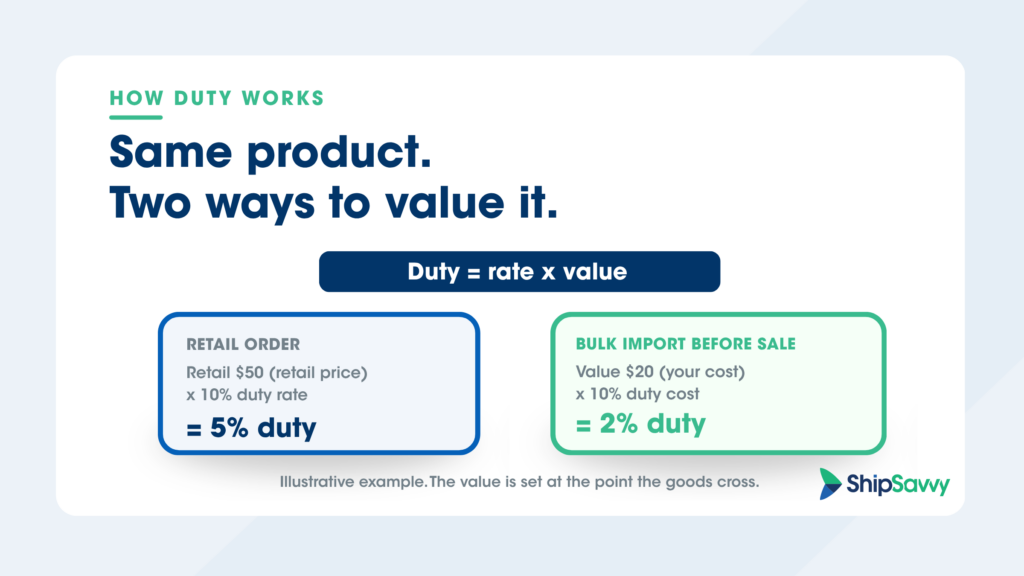
For most sellers, that transaction is the retail order, so the value is the price your customer paid. If you sell a product for fifty dollars at a ten percent duty rate, duty is charged on the full fifty, which is five dollars on that unit.
That is the rule, and on a normal order it is correct. This is the part sellers should not try to get clever with.
Here is the question that opens a different door. What if the goods came into the country before they were sold to that customer at all?
Then the value is not the retail price. It is what you paid for the goods, your cost.
What is the transaction value?
The transaction value is the price actually paid in the sale that brings goods into the US, and it is what customs duty is calculated on. On a normal ecommerce order, that is the retail price your customer paid.
If inventory is imported in bulk before any retail sale, the relevant transaction is your purchase from your supplier, so the value is your cost.
The Importer of Record Move That Can Lower Your Duty
The lever here is the Importer of Record, often shortened to IOR. The Importer of Record is the party legally responsible for goods coming into the US, for making sure the entry is correct, the duty is paid, and the records are kept.
One important distinction. The importer of record is responsible for the goods, but is not necessarily the company physically carrying them across the border.
We are always the ones physically bringing the goods in, while the IOR is about who is legally on record for them. Keeping those two ideas separate is what makes the rest of this make sense.
Here is how it changes your duty. If your inventory is imported in bulk, as a wholesale move, before it is sold to any end customer, the value on that import is your cost.
Back to the example. If your cost is twenty dollars instead of the fifty dollar retail, at a ten percent rate, that is two dollars of duty a unit instead of five.
Same product, lower duty, on every unit. It is not a loophole, it is a different point in the journey at which the goods officially cross.
A Quick Word on Formal Entry Types
Once everything is a formal entry, you will hear about entry types, and two come up most often, Type 01 and Type 11. They sound technical, but the idea is simple.
Type 01 is the standard consumption entry used for most commercial goods coming into the US. Type 11 is an informal entry used for certain lower value or simpler shipments.
You do not need to memorize which is which. The point is that the correct entry type has to be chosen and filed properly, and getting it wrong causes delays and headaches.
We file both every day, so the right entry type is matched to your shipment as part of the clearance. It is one more thing that is our job, not yours.
What It Takes to Become Your Own Importer of Record
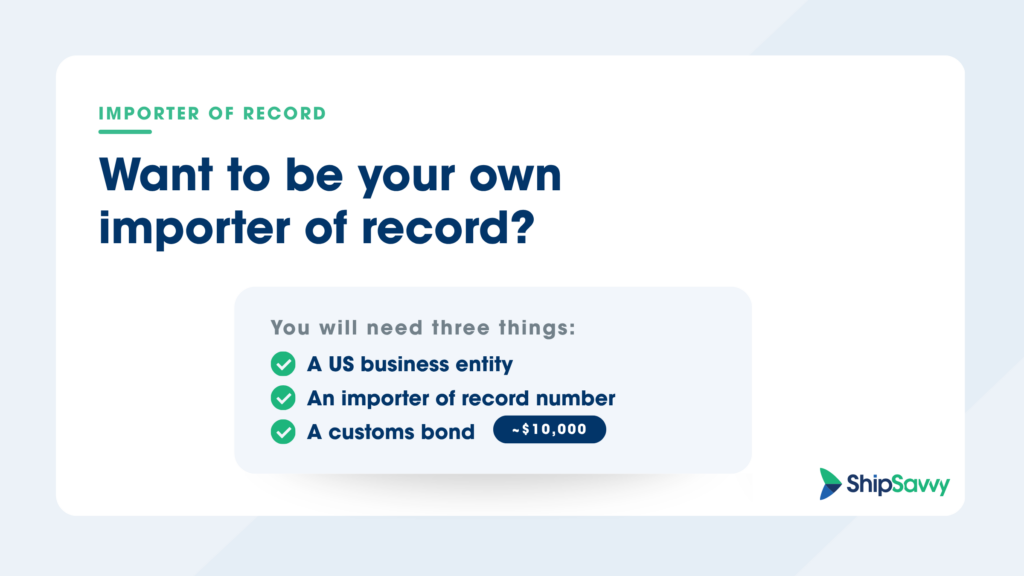
Becoming your own importer of record is not a quick signup, so it helps to know the pieces up front. In most cases you will want a US business entity.
Then you apply for an importer of record number, which is the ID customs uses to track you as an importer, and you complete the paperwork to register.
After that comes the bond. To be an importer, you post a customs bond, a financial guarantee to the government that you will pay what you owe.
That ties up real money, often in the range of ten thousand dollars, held in case customs ever needs to collect. For a lot of businesses, that is a genuine barrier.
So there are two ways to do this. We can act as the importer of record for you, where we carry that role, the bond, and the paperwork, or you become your own, where we help you register and set it up.
What is a customs bond?
A customs bond, also called an assurance bond or clearance bond, is a financial guarantee to US Customs that an importer will pay the duties and fees they owe. Anyone acting as an importer of record must post one.
It often ties up money in the range of ten thousand dollars, held in case customs needs to collect.
Who Is Responsible: You or Your Provider?
Whoever is the importer of record is the one legally responsible to customs. If something is classified or declared wrong, that responsibility sits with the importer of record.
If we are the importer of record, that responsibility sits with us, and so does the bond and the filing. If you are your own, that responsibility is yours, along with the bond and the filing.
Let me make it concrete with a representative seller. Picture April, who sells t shirts, at the end of a long day with her shirts packed and ready to go.
If we are April’s importer of record, her whole job is to get the shirts to us. We are the ones in the files, on the phone with the broker late at night, making sure her product clears.
If April is her own importer of record, that clearing has to happen before the product even comes to us. She is the one going back and forth with the broker, fixing files and filling out paperwork, which is completely fine.
There is also a timing piece. If you get us the product with the import information already in, the clock is on us to clear it, within about twelve hours.
If you send us product that has not been cleared, it simply sits, and that is when storage charges start. That is the practical difference between the two paths.
When Becoming Your Own Importer of Record Makes Sense
So when does becoming your own importer of record actually pay off? It is a margin and a volume decision, not a one size answer.
If you are shipping only a handful of orders, the entity, the registration, and the bond will cost more than you would save. Keep it simple and let your provider carry the role.
Once your margins and your volume are there, the savings on duty can start to outweigh that setup. Where exactly that line sits depends on your products, your duty rates, and your numbers.
That is a conversation, not a formula. It is worth having before you commit money to an entity and a bond.
A useful gut check is your monthly duty bill. If the duty you pay at retail value is large enough that cutting it noticeably would matter to your margins, you are probably in the range where this is worth modeling out.
The Two Paths, Side by Side
We have helped facilitate more than 500 million dollars in ecommerce sales, and almost none of those sellers became customs experts to do it. They picked the importer of record path that fit their numbers and kept selling.
Here is how the two options compare, so you can see where you fit.
| ShipSavvy as your importer of record | You as your own importer of record | |
|---|---|---|
| Legal responsibility | Sits with ShipSavvy | Sits with you |
| Customs bond | We post and carry it | You post it, often around ten thousand dollars |
| Setup required | Minimal, we file and run the entry | A US entity, an importer number, and a bond |
| Duty on bulk imports | Based on your cost when goods come in before sale | Based on your cost when goods come in before sale |
| Best for | Sellers who want it handled | High volume sellers with margin to justify setup |
Neither path is automatically better. The right one depends on your stage, and you do not have to figure it out alone.
Frequently Asked Questions
How is customs duty calculated?
Customs duty is a percentage of the value of the sale that brings goods into the US. On a normal retail order, that value is the price your customer paid. If inventory is imported in bulk before it is sold, the value is your wholesale cost instead.
What is an importer of record?
The importer of record is the party legally responsible for goods entering the US, including making sure the entry is correct, the duty is paid, and records are kept. It can be you, or a provider like ShipSavvy acting on your behalf.
Do I need a customs bond to import into the US?
If you act as your own importer of record, yes. A customs bond is a financial guarantee that you will pay your duties, and it often ties up money in the range of ten thousand dollars. If ShipSavvy is your importer of record, we carry the bond.
Can importing in bulk lower my duty?
It can. When inventory is imported in bulk before it is sold to a customer, duty is based on your cost rather than the retail price, which lowers the duty on each unit. It is a different way of bringing goods in, not a different number declared on the same order.
Is it better to be my own importer of record?
Not always. It is a margin and volume decision, since the entity, registration, and bond cost more than they save at low volume. Once volume and margins are there, becoming your own importer of record can pay off.
Find the Right Importer of Record Path
Here is how I think about it. You could go learn customs valuation, importer of record registration, bond requirements, and US entity setup yourself.
Or you could bring us your numbers and let us tell you, straight, which path actually fits your business. That is the whole point of ShipSavvy.
Duty is charged on the value of the sale that brings your goods in, and on a normal order that is retail, which is what you declare. Import in bulk before the sale, though, and the value can be your cost, which lowers duty on every unit.
Because this comes down to your margins, your volume, and your products, the best next step is a quick call. We will lay out your options, whether that is us acting as your importer of record or helping you become your own.
- Book a call at shipsavvy.com/book-a-demo
- Prefer to start on your own? Create a free account at shipsavvy.com