
Introduction
Picture a candle maker in Hamilton. We will call her Renu, and while she is a composite of sellers rather than one real customer, her story lands in our inbox almost every week.
She built a tidy little business, and about a third of her orders came from the United States. Good margin, happy customers, growing fast.
Then one morning in 2025 the rules changed. Her shipping app started throwing errors, a couple of packages got stuck at the border, and she did what a lot of sellers did.
She switched off US shipping and left a third of her revenue on the table.
Here is the short answer if you are in Renu’s shoes. Yes, you can still ship Amazon FBA and e-commerce orders from Canada into the US in 2026, and it is far more manageable than the headlines suggest.
Section 321 ended on August 29, 2025, so every shipment is a formal entry now. The added cost is small, and goods made in Canada, the US, or Mexico can often cross the border duty-free.
I am Tony from ShipSavvy. We are not a software company watching from the sidelines, we run our own e-commerce businesses and ship across the border every single day on our own behalf.
In this guide you will learn what actually changed, what clearance really costs, why where your product is made can make duty disappear, and the simple way to turn US shipping back on without becoming a customs expert.
What This Guide Covers
- Can you still ship to the US from Canada in 2026?
- What actually changed: Section 321, de minimis, and tariffs
- What it really costs to ship to the US now
- Why country of origin decides your duty bill
- How to turn US shipping back on without becoming a customs expert
- What smart sellers are doing differently in 2026
- The real math for a standard Canadian seller
- Frequently asked questions
Can You Still Ship to the US From Canada in 2026?
Yes. Canadian sellers can still ship into the United States in 2026, and the process is more routine than the fear around it suggests.
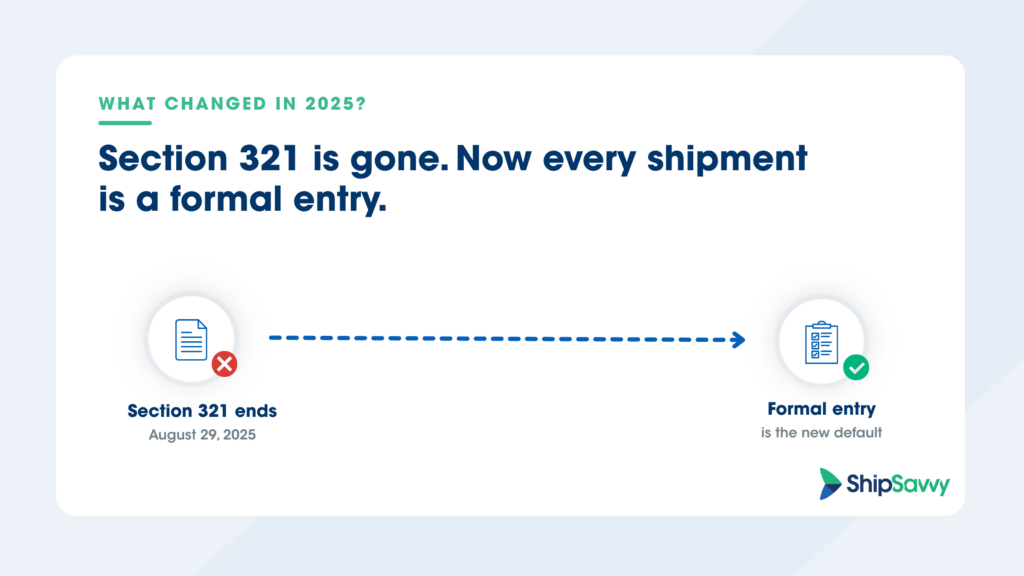
What changed is the paperwork, not your access to the market. Since Section 321 ended, every shipment goes through a formal entry, which is the full official customs process for bringing goods into the US.
The thing that trips people up is what triggers that process. It is the dollar value of the order, not the size of the box.
A small light package worth a few hundred dollars goes through the same formal entry as a pallet. Whether your order is worth 5 dollars or 5,000 dollars, it clears the same way now.
So the question is no longer whether you can ship. It is whether you have someone handling the clearance for you so you do not have to think about it.
What is a formal entry?
A formal entry is the full, official customs process for bringing goods into the United States.Your product gets a classification code, its value is declared, and the shipment is loggedand cleared properly instead of being waved through.Since Section 321 ended, this applies to every cross border shipment regardless of size orvalue.
What Actually Changed: Section 321, De Minimis, and Tariffs
The shift started with a rule called Section 321 and an idea called de minimis. De minimis just means a value low enough that the government does not bother charging duty on it.
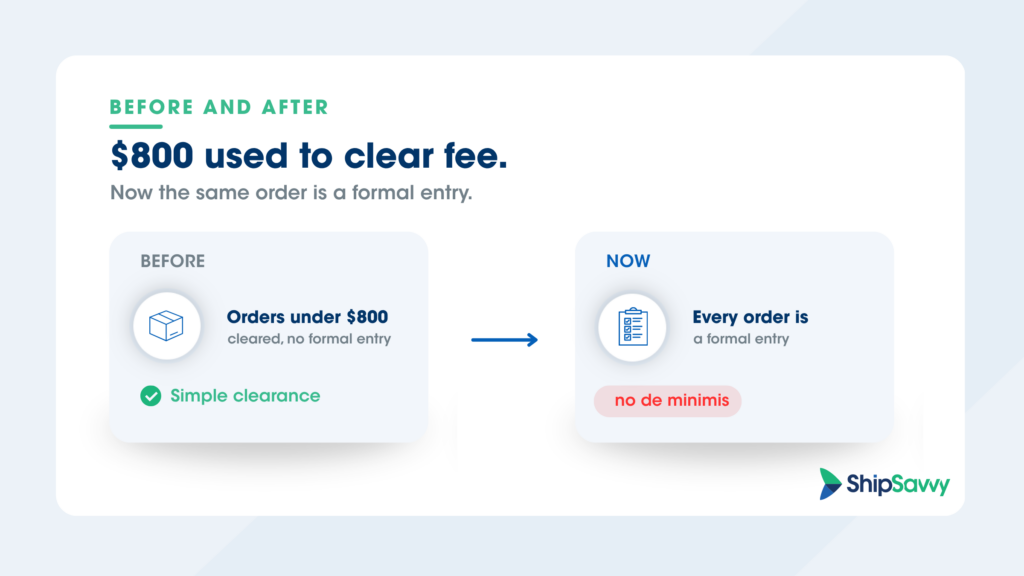
For years that threshold sat at about 800 dollars. If your shipment into the US came in under 800 dollars, it cleared the easy way, with no duty and barely any paperwork.
That is how most Canadian sellers shipped, and most of us never thought twice about it. It was quiet, cheap, and it worked.
Then the exemption was pulled. It came off China and Hong Kong origin goods first, on May 2, 2025, and then it was suspended for all countries on August 29, 2025.
Since then the conversation has grown well past Section 321 into tariffs more broadly. New rounds have changed what different products owe, and some categories were hit hard, with certain goods facing rates in the range of 400 to 600 percent almost overnight.
Here is the practical part that matters for you. Everything is a formal entry now, and what you owe in duty depends a lot on what your product is and where it was made.
That is why Renu suddenly saw errors and held packages. The rule she had been relying on without realizing it simply went away.
What It Really Costs to Ship to the US Now
Most sellers hear formal entry and duties and assume the math is dead. It is not, once you separate the two costs that are actually involved.
The first cost is handling the clearance itself. When we run the brokerage for you, that runs around two dollars a package, and closer to five dollars if you bring your own broker.
The second cost is duties and taxes, and those are separate. They depend on your product, mostly on where it was made, and for a lot of Canadian sellers that number can come down to very little or even zero.
So the picture is not a wall. It is a small handling cost, plus duties that often come down to your sourcing.
Now think about what that buys back. It is the entire US market, the one Renu walked away from.
The sellers who understood this early are the ones quietly taking the customers their nervous competitors abandoned. When the rules tightened, a lot of shippers got scared and left the field open.
Why Country of Origin Decides Your Duty Bill
Here is the lever almost nobody talks about, and it can matter more than your carrier choice. It is where your product is made.
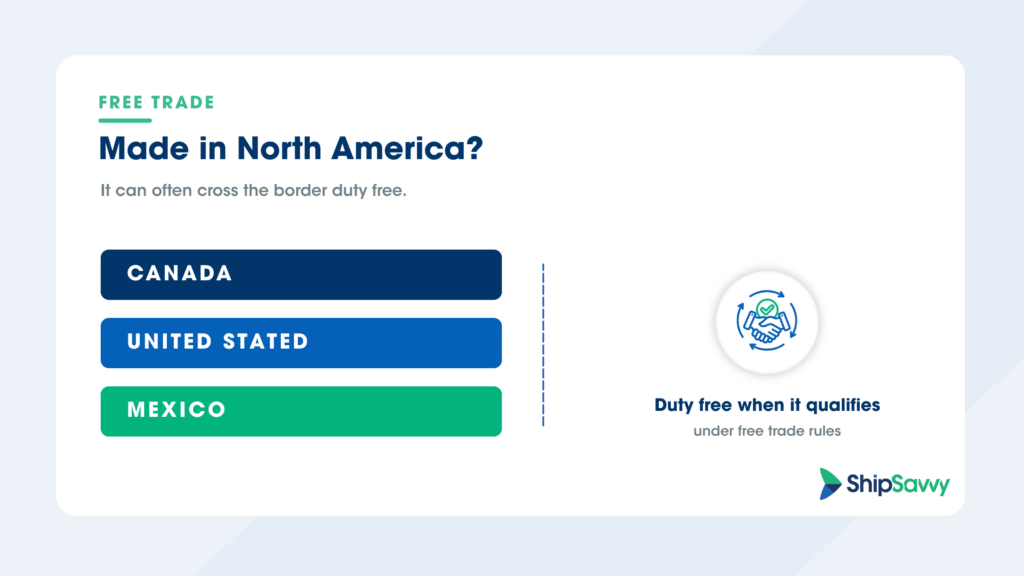
If your product is made in Canada, the United States, or Mexico, it can often move across the border duty-free. That is because of the free trade agreement between the three countries.
So a Canadian-made product going into the US frequently pays no duty at all. A lot of sellers have that edge and do not even realize it.
But if your product is made somewhere else, the country of origin changes everything. Same product, two different factories, two completely different duty bills.
We have seen an item from one country get hit hard while the exact same item from another country barely moves the needle. China versus Vietnam is the classic example right now.
So here is the practical takeaway. Go look at where your products are actually manufactured, not where you bought them, but where they were made.
That one piece of information drives your whole landed cost. Landed cost just means the all-in
cost to get the product to your customer’s door.
How to Turn US Shipping Back On Without Becoming a Customs
Expert
The good news is that turning US shipping back on does not mean learning customs codes at midnight. It comes down to three steps.
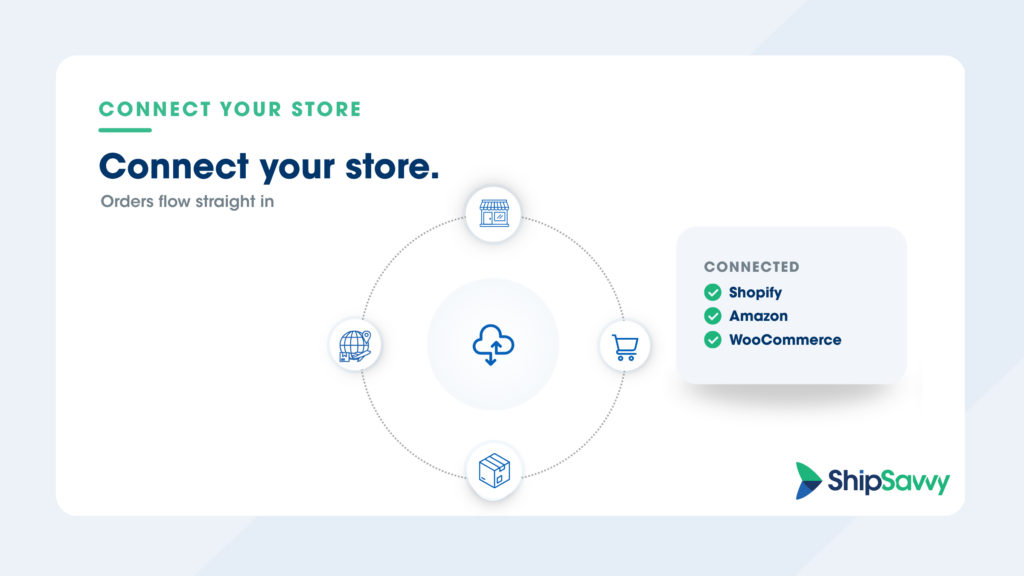
Step one, connect your store.
If you sell on Shopify, Amazon, or WooCommerce, or you run ShipStation, you link it once and your orders flow straight in.
You are not copying addresses by hand or uploading spreadsheets every morning. Honestly, our goal is for you to spend as little time in our platform as possible so you can be out with your customers instead.
Step two, let the customs side get handled for you.
This is where SavvyBroker comes in, and it acts as your importer of record.
The importer of record is the party officially responsible for bringing your goods into the US and making sure the entry is done right. Instead of you registering as an importer and wrestling with customs codes, SavvyBroker takes that role and manages the whole clearance process on your behalf.
It lines up the HTS code, which is the international product number that tells customs what your item is, and makes sure the value and details are right. We file Type 01 and Type 11 entries every day and work with licensed brokers to get your shipment cleared. You do not become the customs person. We carry that load.
Step three, save real money on the actual shipping.
Because we move more than two million packages a year, we have carrier rates most sellers cannot get on their own, and the platform compares them for you.
Those savings can be significant, often more than enough to offset the small clearance cost from step two. No contracts, no minimum volume, and you can set up the same day.
What Smart Sellers Are Doing Differently in 2026
The sellers pulling ahead this year are not doing anything magic. They simply did not panic when Section 321 went away.
When the rules tightened, a wave of shippers got scared and walked away from cross border orders, FDA goods, and anything that looked complicated. That left a lot of customers without a supplier and a lot of shelf space open.
The sellers who stayed in the game are quietly absorbing that demand. They treat clearance as a line item to manage, the same way they manage payment processing fees, not as a reason to retreat.
You do not need to match a giant importer’s customs team to compete. You need a setup where your orders flow in, the clearance is handled, and your duty stays as low as your sourcing allows.
That is the entire difference between the sellers who shut off the US and the ones taking their customers. One group saw a wall, the other saw a process.
The Real Math for a Standard Canadian Seller
Let me put a bow on it the way I would explain it to another operator. Yes, you can still ship to the US from Canada, and every shipment is a formal entry now, but that is a process, not a wall.
On cost, the clearance handling runs around two dollars a package when we handle the brokerage, and closer to five if you bring your own. Duties and taxes are separate from that, and we help manage the filing, we do not make those costs disappear.
Here is the hopeful part on duties. If your product is made in Canada, the US, or Mexico, it can move duty-free, so for many sellers that piece comes down to very little.
And the customs side, the part that scared your competitors off, can run quietly in the background. Meanwhile, you do what you actually do best, which is sell.
That is the whole game for a standard seller. A small, predictable handling cost, duties that often come down to your sourcing, and the US market back on the table.
Frequently Asked Questions
Can Canadian sellers still ship to the US after Section 321 ended?
Yes. Canadian sellers can still ship into the US in 2026. Since Section 321 ended on August 29, 2025, every shipment is a formal entry, but the added handling cost is small and the market is fully open to sellers who keep shipping.
How much does it cost to ship to the US from Canada now?
There are two separate costs. Handling the customs clearance runs around two dollars a package when ShipSavvy manages the brokerage and closer to five dollars if you bring your own. Duties and taxes are separate and depend mostly on where your product is made.
Do Canadian made products pay duty when shipped to the US?
Often they do not. Goods made in Canada, the United States, or Mexico can frequently move across the border duty free under the free trade agreement between the three countries. Where your product is manufactured, not where you bought it, is what determines this.
Does the size of my package affect customs?
No. What triggers a formal entry is the dollar value of the shipment, not the size or weight of the box. A small light parcel worth a few hundred dollars clears the same way as a large one.
Turn the US Market Back On
Here is how I think about it. You could go learn all of this yourself, the tariff changes, the formal entry process, the country of origin math, the carrier optimization and spend the next month becoming a part time customs expert.
Or you could keep running your business and let us handle the border for you. That is the whole point of ShipSavvy.
The sellers winning right now are not the ones who became compliance experts. They are the ones who kept selling while someone reliable carried the customs load.
If that sounds better, go to shipsavvy.com and create a free account. You can set up the same day, there is no contract, and you can connect your store in a few minutes.
Connect your store, and the version of you that switched off the US a year ago gets that market back. Ship the savvy way, and let the border run quietly in the background.
- Create your free account at shipsavvy.com
- Or book a call and we will map out your cross-border setup with you